Intro: DNA acts as the permanent master blueprint for your body, stored safely in the cell’s nucleus. RNA is the mobile copy of those instructions that travels to the cell’s “factory” to actually build proteins. While DNA is a stable double helix using the base Thymine (T), RNA is a single strand that swaps T for Uracil (U) to get the job done.
Similarities
- Both made of nucleotide subunits: phosphate group, sugar, nitrogenous base
- Both contain Adenine (A), Guanine (G), and Cytosine (C)
- Monomers connected by covalent bonds
- Both have 3′ and 5′ ends
- 3′ end = hydroxyl group (OH)
- 5′ end = phosphate group
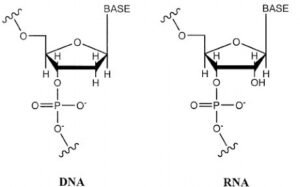
All nucleic acids need phosphate and nitrogen
DNA
- Contains Thymine (T) instead of Uracil
- Has only H on the 2nd carbon of its sugar (deoxyribose)
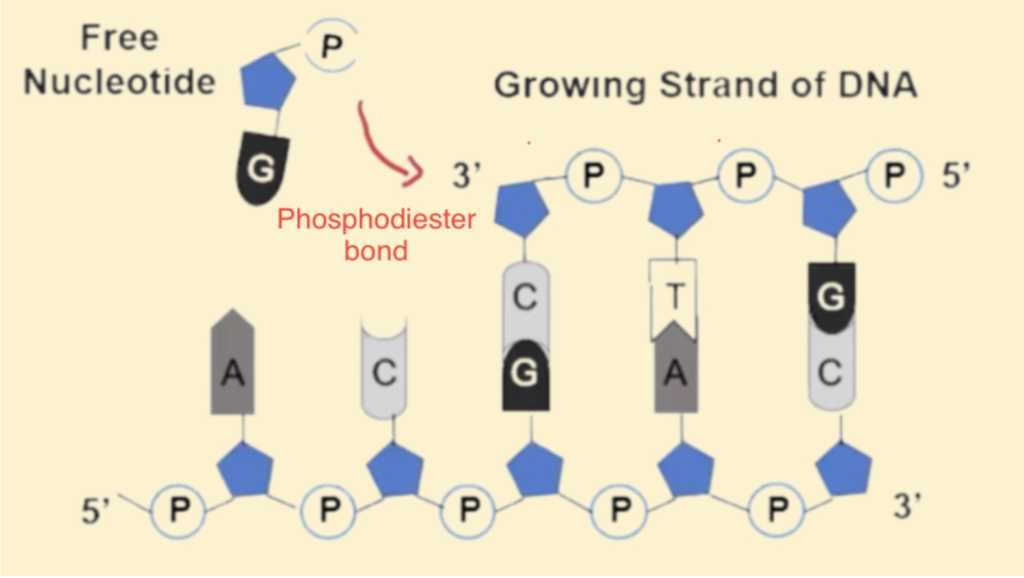
- Antiparallel — the two strands run in opposite directions (one 3’→5′, the other 5’→3′)
- Nucleotides connected by phosphodiester bonds (covalent)
- The two strands are held together by hydrogen bonds between base pairs
- A–T = 2 hydrogen bonds
- G–C = 3 hydrogen bonds
- More hydrogen bonds = stronger connection
- New nucleotides can only be added to the 3′ end
RNA
- Contains Uracil (U) instead of Thymine
- Has an OH on the 2nd carbon of its sugar (ribose)
- Hydrogen bonding between base pairs creates elaborate 3D shapes
- G–C = 3 hydrogen bonds
- A–U = 2 hydrogen bonds
- More hydrogen bonds = stronger
Key understanding
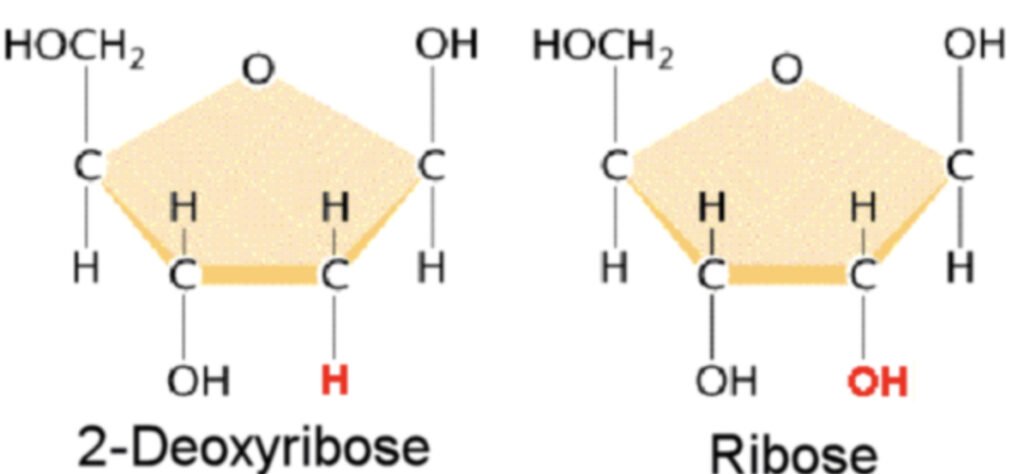
The “H” instead of “OH” on the 2nd carbon is what allows it form double strands.